Information overload: what the research says (and three checks to run today)
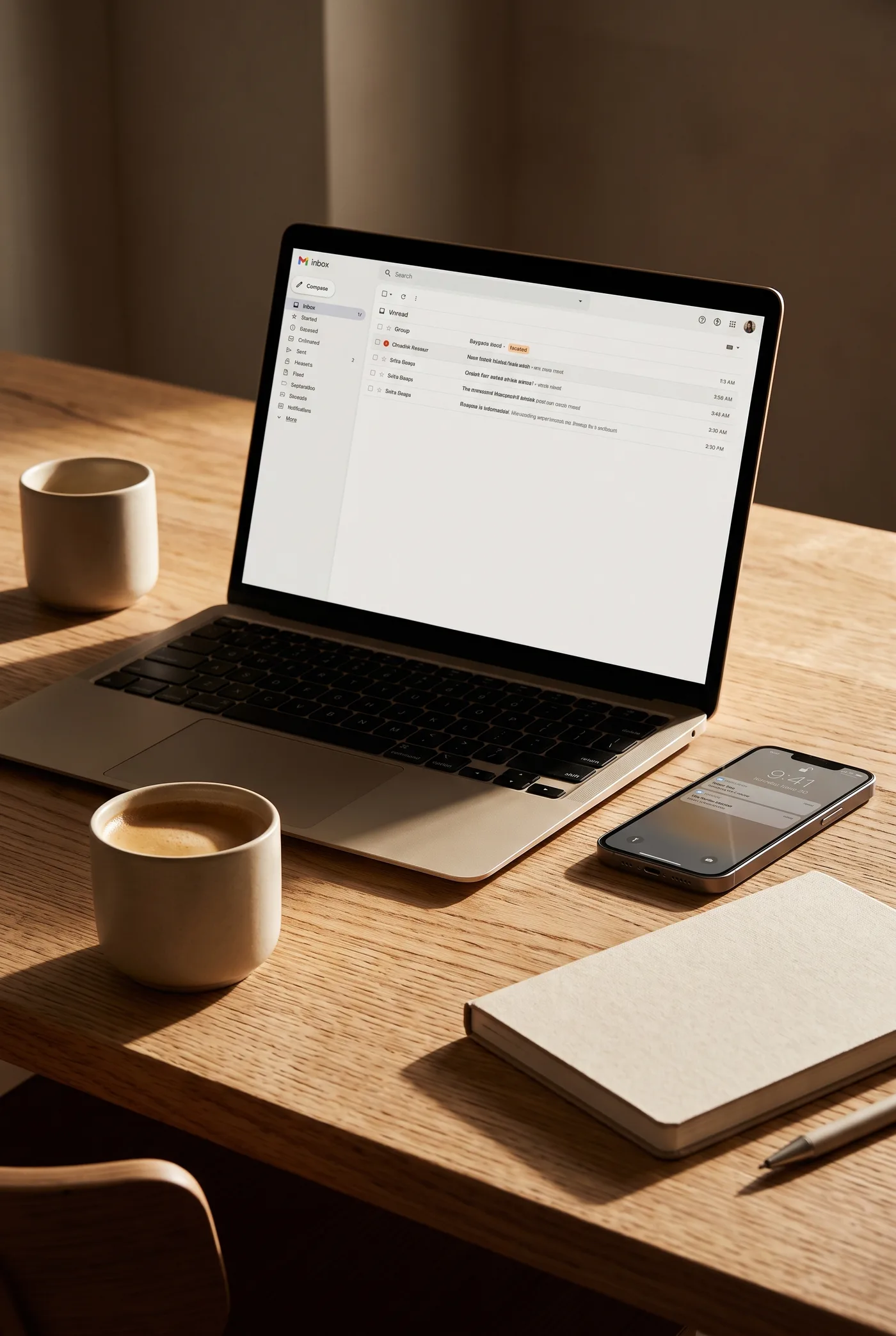
You open your inbox, scroll through three feeds, hop from one newsletter to the next, and by the end of the morning you feel you've been working, yet you haven't decided anything. That feeling is more than an annoyance: it is an operational and cognitive cost, and researchers have tried to measure it. Information overload eats attention, fragments deep work and turns curiosity into a habit that steals time.
The point is not to demonize the news. It is to recognize that when information arrives in waves and through too many channels, the real work shifts: you are no longer “reading”, you are filtering. And that filter, applied by hand a thousand times a day, is the part that never shows up in your calendar.
The hidden cost of reading without deciding
Information overload is, put simply, the point at which more information comes in than you can turn into a decision or a clear priority. It shows up when your daily catch-up becomes a patchwork of inboxes, RSS readers, browsers full of open tabs, push notifications and “read this at the weekend” links that sit there for weeks.
The phenomenon has an economic side too. Workplace stress, of which overload is one cause, costs American industry more than $300 billion a year in absenteeism, lost productivity and healthcare bills.[WorkTime] Even without turning those figures into a personal average, the practical message is clear: attention is the scarce resource, and noise burns through it before you ever get to think about the content.
Workplace stress in numbers (2026)
- 51% of Italian workers report high stress levels, twelve points above the European average.[Funnifin]
- 77% of employees in the United States experienced at least one symptom of work-related stress in the past month.[WorkTime]
- 1 million Americans miss work every day because of stress.[WorkTime]
In this context, the loss is not just reading time but the sum of repeated micro-decisions: open or skip, save or discard, trust or verify. Strung together, they become a tax on clear thinking.
Fear of missing out stalls the work
Informational FOMO is not a sign of shallowness. It comes from a real incentive: plenty of work decisions depend on being up to date. The trouble is that when every signal looks urgent, you end up reacting to everything and digging into very little, repeatedly interrupting whatever you were doing.
An experimental study of workplace interruptions, presented by Gloria Mark at CHI 2008 (The Cost of Interrupted Work: More Speed and Stress), found that people can compensate for interruptions by speeding up, but they report more stress, frustration and pressure.[Gloria Mark, CHI 2008] According to Mark's research at the University of California, Irvine, often quoted with the figure of 23 minutes and 15 seconds, the time it takes to get back to full concentration after a switch is anything but negligible.
Prolonged tension in the workplace is one of the surest routes to burnout. Stress is a state of pressure that still keeps a certain level of engagement, whereas burnout is a state of chronic exhaustion and emotional detachment, marked by a loss of motivation.[GoBright]
In practice, the routine of checking “in between things” is not an efficient way to keep up. It is a reliable way to stay in reactive mode, where everything feels like a priority.
The news landscape of 2026 makes this dynamic even more likely. The Reuters Institute Digital News Report 2026 describes a growing “platformisation”: globally, 54% of respondents use social media for news, overtaking the outlets' own websites (51%). In the same report, trust in news falls to 37%, while concern about misinformation rises to 62%.[Reuters Institute] When access is more mediated and less intentional, the news reaches you while you are doing something else. The result is less reading by choice and more reading by default.
Subscribing to everything is a strategy bound to fail
The most common response to information chaos is to add sources, but beyond a certain threshold each new source mostly adds overlap.
Duplicate news has a measurable cost: out of roughly half an hour of reading a day, ten minutes go to repeated stories or sponsored blocks. Ten minutes a day adds up to five hours a month, as we worked out in our post on how much time you waste reading duplicate news.
The sneakier cost is not the clock but the distortion of importance. When the same story reaches you four times, it starts to look more relevant simply because it is frequent, not because it is useful.
On top of duplication comes native advertising. Of 40 newsletters we analyzed, 30% contained at least one declared sponsored block. In Italy, where trust in news stands at 32% in 2026 and concern about misinformation at 59% (Reuters Institute data), the temptation to verify by reading everything is understandable. But if you have too many sources, all you are doing is multiplying duplicates.
From noise to deliberate selection
If the problem is a hidden cost, the first useful move is to change the metric: not how many stories you read, but how many times you have to decide whether to read them. When selection is done well, you don't lose coverage; you lose friction. And you win back time to connect the dots and choose what matters.
This is where the difference between a feed and a briefing comes in. A feed shows everything in chronological order and offloads the filtering onto you. A briefing is born as a synthesis: it groups the stories about the same event and highlights what is new.
The Digital News Report 2026 also records growing use of AI chatbots to get news (10% weekly, 16% among under-35s), where the most valued feature is the ability to ask follow-up questions.[Reuters Institute] That fits with deliberate selection: having a piece of news is not enough; you need to be able to question it quickly.
Put a number on the hours lost to irrelevant content
To cut overload, start with three checks for one week: note how many times you open a story you've already read, notice which stories arrive only once, and count how many sources cover the same niche. This shifts the focus from feeling inadequate (“I can't keep up with everything”) to assessing the system (“my input produces noise”), and gives you room to maneuver again.
| Stress factor | Impact on productivity | Estimated cost |
|---|---|---|
| Duplicate and overlapping news | About 10 minutes lost per day per user | ~5 hours a month per employee |
| Constant interruptions | Up to 23 minutes to regain concentration | Lower quality of work and higher stress |
| General chronic stress | More presenteeism and turnover | Lost productivity and replacement costs |
On the same point, coverage of World Organizing Day described the effect of “info-bulimia” on wellbeing and on the risk of burnout.[Il Messaggero] When overload is continuous, the brain stays on alert and the work of evaluating becomes more fragile.
Bring the useful sources together in one tidy place
Once you've measured the noise, the question becomes: where do you cut? Not the news, but the steps. Bringing your sources together reduces the scatter between inbox, reader and browser, so the information arrives already cleaned of duplicates and sponsored content.
In that sense, an AI RSS feed aggregator is a step beyond a classic reader. RSS solves access to content; AI adds deduplication, summaries and priorities. The goal is not to see more links but fewer repeats. If you track several topics at once, that is the whole logic behind centralizing your sources in an AI RSS feed aggregator.
On Proofite, this translates into a single stream: newsletters, RSS feeds, web searches, Substack, X profiles and saved links flow into topic inboxes and become a personalized digest. When you need extra context, you can interrupt the podcast host and ask a question, without opening another tab. The most honest test is to plug in the sources you already follow and measure, over a few days, how much of that decision fatigue disappears.
The most direct way to start is to create a digest and use the daily briefing as your baseline: not to read more, but to decide with less noise around you.
Sources
- [Gloria Mark, CHI 2008] The Cost of Interrupted Work: More Speed and Stress
- [Reuters Institute] Digital News Report 2026
- [Il Messaggero] World Organizing Day, contro lo stress da info-bulimia
- [WorkTime] 44 statistiche sullo stress sul lavoro per il 2026
- [Funnifin] Stress finanziario e produttività: i numeri in azienda
- [GoBright] Che cos'è lo stress sul posto di lavoro e perché è importante nel 2026